Brett and Andrew break up
The Life ListBrett and Andrew break up after a confrontation over whether Brett will help him secure a position in her family’s business. The decisive moment is Brett’s refusal: she could use her influence to arrange a job, but chooses not to go against her mother’s judgment. Andrew treats that refusal as the end of their shared future, and Brett is left to reckon with the relationship’s collapse and the costs she associates with it.
Causes and Stakes
The argument begins with practical questions about their future. Brett suggests looking for something smaller that they can afford by pooling their savings. Andrew responds by pointing to her expected inheritance, making money the immediate pressure point in their conversation. Brett’s anxiety has been building for weeks, and she asks whether he would still help with her list if there were no inheritance. His question about whether this is a test turns the exchange from financial planning into a dispute about trust and motive.
Brett presses the distinction because she wants to know whether Andrew’s willingness to take part in her goals depends on her money. He answers angrily that he is not pursuing her fortune and says he is practically begging for a job. He lists the requests he has already accepted: her dog and her teaching job. In return, he wants a position in the family business, with a salary. His support for the list and his request for employment thus become entangled. The scene does not establish that every part of his support is insincere; it makes clear that the job is a condition he considers important enough to demand in return.
The Refusal
Andrew insists that Brett has the power to bring him into the company and that he needs to know she will help him with his own goals. His request is not impossible for her to fulfill. Brett recognizes that she could call Catherine Humphries-Bohlinger on Monday, and that Catherine could likely find a place for him within a week or two. As an attorney, Andrew might fit the legal team, finance department, or human resources. Brett understands that one affirmative answer could ease the evening’s tension, but she cannot make herself give it.
She refuses softly, explaining that her mother opposed the idea and rarely made a poor business decision. The refusal is therefore more than a denial of a favor: Brett declines to override her mother’s judgment even though she has the authority to act. Andrew jerks away when she reaches for his hand and says she has changed, contrasting the person she has become with the agreeable woman he fell in love with. Brett acknowledges that he is right about the change, wipes away a tear, and apologizes for ruining the evening. The exchange makes the cost of her decision immediate and personal: the same independence that lets her refuse him is, to Andrew, evidence that she is no longer the partner he chose.
The Break and Its Immediate Aftermath
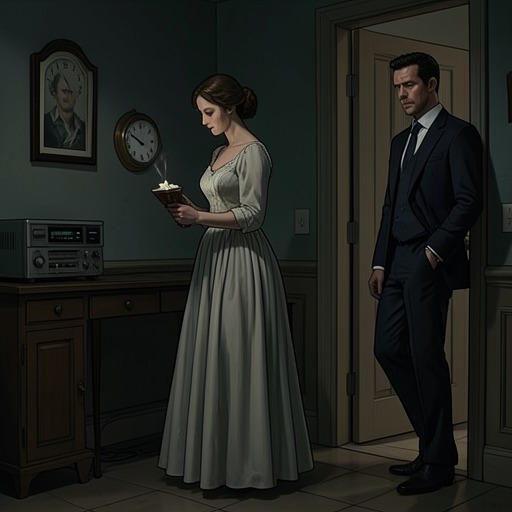
Andrew paces the room, dragging a hand through his hair. Brett reads his behavior as a decision about whether she will remain part of his life. She watches, unable to speak and barely able to breathe, while he stops at the bay window with his back to her. When he turns, his verdict is blunt: “You just ruined your life, baby.” The line casts the breakup not simply as the loss of a romance but as a sentence on Brett’s whole future. The threat lands while she is already confronting the consequences of losing her job and home and worrying that the inheritance may be the only prospect she has left.
Brett’s thoughts show how deeply she has tied those losses to Andrew. She recognizes that he could be difficult and sometimes a jerk, yet calls him her jerk; without him, she fears she will never get pregnant. These are her immediate perceptions in the wake of the argument, not an objective accounting of what will happen. Their force lies in how one refusal appears to gather several anxieties into a single night: financial security, housing, motherhood, and the loss of a long-standing partner.
Meaning of the Scene
After the confrontation, Brett cannot bring herself to sleep in her mother’s bed. She thinks of her mother as the enemy because she believes her mother’s decisions have cost her her job, home, and hope. Brett drags a comforter downstairs and settles on the sofa. Across the room, she sees a photograph of her mother at an awards ceremony, taken two years earlier when Elizabeth Bohlinger was named Chicago’s Businesswoman of the Year. Brett remembers the signature boyish crop of her mother’s salt-and-pepper hair and sees in the image not only beauty but also wisdom and serenity. She takes the photograph from its place and sets it on the coffee table in front of her.
The image becomes the focus of Brett’s unresolved accusation. Looking at her mother’s photograph, she asks, “Did you plan to ruin my life, Mom? Is that what you wanted?” The scene closes not with reconciliation or a practical solution, but with Brett addressing the absent woman whose judgment she has just chosen to honor and whose influence she now resents. That contradiction gives the breakup its particular weight: Brett’s refusal is an act of agency, yet its immediate aftermath is framed by her fear that she has sacrificed too much to make it.